vendredi 30 mai 2008

I have to confess that before seeing this movie, I had absolutely no idea that Anne Boleyn even had a sister, or that this sister had been involved with Henry VIII. A shameful gap in my education, I agree. Independently of such lack however, I quite enjoyed watching the movie which stars Natalie Portman, Scarlett Johansson and Eric Bana.
It’s the story of Anne and Mary Boleyn and their rise in English court thanks in large part to the machinations of their father and uncle, the latter being the influential Duke of Northumberland. In order to secure the royal favor, first Anne, then Mary are offered up to King Henry, who was desperate to have an heir. Unfortunately, as all history books do point out, things do not go well for the Boleyns and Anne ends up dead for all their trouble and scheming. Things go a little better for Mary who ends up happily married and retired in the country.
The best part of this movie is probably Natalie Portman’s inspired and fiery performance. Her Anne is scheming, forceful and completely seductive. It is little wonder that the English king was so smitten with her. Portman does a great job playing Anne, with her mobile face reflecting her every mood and scheme. In contrast, Johansson’s Mary is a much more docile creature, with a kind of pale sweetness that offers a striking contrast to Anne. I think of the three principal actors however, Eric Bana is woefully miscast as Henry. While Bana does a good job stomping about and being king, there is something less than convincing about his performance. Or it could be that I just can’t help but remember his turn as the Incredibly Hulk.

A literary treat

Chez Moi by Agnes Desarthe was originally published in French under the title Mangez-moi (Eat Me) to great acclaim. It is the sixth novel of Desarthe. Fortunately for us Anglophone readers, it has now been translated in English.
It’s the story of Myriam, who at 43, decides to open a small restaurant. The story gradually unfolds in careful layers and slowly it becomes apparent that it is as much as story of redemption and new beginnings as much as it is about a restaurant. She comes to open a restaurant without knowing anything other than cooking. And because she has literally talked her way through the bank and suppliers, she is forced to live in the restaurant in order to conserve her ever dwindling resources.
The story’s theme of starting over after a grave misfortune is a universal one. Myriam’s character is a fully fleshed and sympathetic one. Her foibles are even endearing. Desarthe has a real talent for writing scenes that ring with the truth. There is one particularly memorable scene in the book which captures perfectly the double life that Myriam leads. She is caught between the actual universe which consists of what is going on in the restaurant and the virtual one which are what she receives in the post and is instantly lost in the labyrinth of drawers: “the forms and summonses crouched in terms that are barbaric…. and figures which always seem to accumulate in the same column, the debit column.” It evokes a sentiment that I’m sure we can all identify with. I for one can confess to often feeling as Myriam does, “like those parched landscapes where the depleted groundwater can no longer hold together the cracked soil, those sterile expanses cleaned out by summer storms but never actually slaked by them.” And her wondering plea why the money that comes into the till never reaches into that dark parched pipework, not even the tiniest droplet to quench the thirst of the paper monster, is another resounding element.
It is for this reason that Chez Moi can be a highly personal read. We can identify with her and as such root for her more deeply than we would in other redemptive stories.

mercredi 28 mai 2008

Mémoire collective


Si le festival de Cannes est un moment fort important dans l'histoire du cinéma, ce n'est pourtant pas le festival qui révèle (à mon sens) les meilleurs crus. C'est devenu malheureusement un événement bien plus jet-set que cinématographique. Le Sundance festival ou celui de Berlin semble décerner des prix à des films un peu plus pointus.

Et puis les Touristes m'a fait découvrir un nouveau festival (honte à moi, mais les festivaux étant de plus en plus nombreux, on s'y perd..): le festival International du film d'Histoire. Ce film a en effet eu le prix du film d'histoire catégorie fiction en novembre dernier.

Sven, jeune Berlinois du 21ième, siècle choisit de faire son service civil à la place du service militaire, et opte pour Amsterdam. La vie étant mal faite, il se retrouve à Auschwitz, cette destination étant beaucoup moins demandée... Les touristes y affluent, et Sven devra confronter ses idées reçues (du tourisme dans un camp de concentration?) à la réalité ambiante, et à la population locale.

Si Aischwitz est généralement synomyme de Shoah dans la mémoire collective, ce film va plus loin, et se penche sur la question de la reconstruction. Reconstruction de la population polonaise, reconstruction de la population juive, reconstruction des allemands face à leur passé. Comme la plupart des bons films d'auteur, celui-ci ne fait que poser des questions, et semer des pistes de réponse sans jamais les imposer....

mardi 27 mai 2008

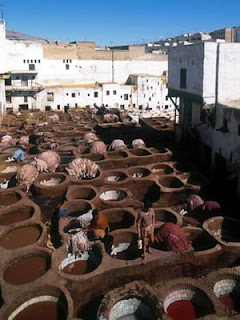
Fes

After a long silence, I finally have the chance to sit down and write some thoughts about the different places we had the occasion to visit during this merry month of May.
Fes has to be one of the world’s most unique places to visit. The first glimpse of the Medina is a sight to take one’s breath away. It is the most ancient of Morocco’s imperial capitals and one of the most complete medieval cities of the Arabic world. Little wonder that it was for centuries the country’s dominant city for political and religious life, trade and culture. During the medieval times, it was one of the most advanced centers of mathematics, philosophy and medicine.
The city is now divided into two—the Medina, which is the old city and the Nouvelle Ville which was built by the French. It is however the old city which provides most of the charm and allure. It is a vast warren of streets that snake and branch off to little hidden corners and cul-de-sacs. It is lined with shops selling all manner and type of produce and there is such a cacophony of sounds and smells that one is easily transported back to the medieval times. Here in the souk, it seems to me that commerce here is conducted in a way that has not changed much since its beginning, complete with donkeys loaded with panniers that you meet head on while you traverse the tight winding passages. The calm and dimly lit archways of the mosques of the old city provide an almost welcome relief to all the hustle and bustle going on.

One other thing that hasn’t changed since the beginning is the fabled tanneries of Fes. The biggest tanneries are those of Chouwara. In order to view the tanneries, we were taken up a set of winding stairs and warned to pick up a sprig of mint leaves. The reason for the mint leaves became apparent as soon as we stepped off the terraced roof to view the tanneries. The stench hit us with an almost physical force and got past the mint leaves that we frantically clutched to our nose. Despite the smell, it is fascinating to watch the multitude of skins drying in the sun or soaking in their traditional bath of pigeon urine (yes, you read that right, pigeon urine works as a natural ammonia) and vegetable dye. The process has changed very little since the 16th century when Fes became the preeminent leader of leather production.
Once you’ve exhausted yourself wandering around the souk and have had your fill of all the leather products being sold, it is pleasant to sit in a café, preferably with a view of the Medina drinking a cup of the wonderfully ubiquitous mint tea. What better way than that to end a visit to Fes?

Because of all the plane rides I've taken this month, I've had some pretty solid reading time. One of best ones I've read and a current favorites is The Brief and Wondrous Life of Oscar Wao by Junot Diaz. It is the debut novel from Diaz, whose first book was a collection of short stories. From the moment I started reading it, I was loathed to give it up and only the charm of a new city was a good enough reason to put it down.


The story revolves around Oscar, who’s unfortunate obesity gets in the way of his search for love and career. It is also the story of his family particularly their life in the Dominican Republic and their subsequent flight to New York. Woven into this family story is the greater saga of the country and their travails under the dictator Rafael Trujillo. But this is no normal family saga because of the involvement of fuku. Fuku for all of us unitiated is a curse, one that afflicts the whole island –especially personified by the dicatator Trujillo and unfortunately for Oscar, his family is particularly cursed. You might say that this book is chock full of magical realism but it is vastly different from the fiction of other Latin American authors such as Allende or even Cortazar. And this is due in large part to Junot’s writing. His writing is by turns, engaging, imaginatively complex and humourous. It is impressive the way his language captures just the right tone of humor and pathos and even the tough street talk of the characters.


What I particularly loved about this book was the way it incorporated elements of fantasy and science fiction. There are references to Tolkien, Norton and Le Guin and it is done in such an innovative way that you can't help but be impressed. I'd never seen a book do such a great job referencing the science fiction/fantasy genre. If you’re not a fan of such genres, you will appreciate the flashes of Gabriel Garcia Marquez and even Herman Melville. Small wonder then that Junot gathered such prizes such as the Pulitzer Prize for Fiction for 2008 and the National Book Critics Circle Award for 2007. This totally cool book is a must read!

lundi 26 mai 2008

Pour les sportifs philosophes aguerris

J'essaie d'alterner essais et romans, mon inclinaison naturelle me faisant pencher vers ces derniers. Ce qui n'est pas honteux en soi, mais ce qui ne permet pas forcément de combler mes trop grandes lacunes culturelles.

Toute de bonne volonté donc, je me suis attaquée au Corps Redressé de Georges Vigarello. J'avais déjà lu son Histoire de la Beauté, qui n'était déjà pas une lecture facile, mais cet ouvrage va un cran plus loin dans la difficulté.

Georges Vigarello se donne pour mission d'étudier le redressement du corps du XVII ième à 1950 (dommage, les années 1950 à aujourd'hui étaient celles qui m'intéressaient le plus, la prochaine fois, je prêterai davantage attention au résumé). Cet essai, destiné aux élèves de STAPS (qui permet entre autres de devenir professeur de sport), est extrêment ardu, d'autant plus que l'auteur est philosophe. Cependant comme tout effort est récompensé, pour peu que la concentration soit là, l'analyse est fort intéressante. Le redressement du corps traduit l'évolution de la société et des sciences. De même que la mode est le reflet sociologique de l'époque, l'attitude corporelle suit inconsciemment la montée de la bourgeoisie, la découverte du fonctionnement du corps humain, l'évolution de la pédagogie entre autres paramètres. Pour celui qui est un tant soit peu sportif et curieux du fonctionnement de son corps et de la genèse du sport, ce livre est une excellente lecture. Pour les autres, passez votre chemin.

Sur ce, je vais pouvoir me replonger avec délectation dans un roman...

dimanche 25 mai 2008

Du Truffaut, fidèle à lui-même


J'ai enfin pu voir Jules et Jim, dont on parle tant. Je ne savais rien du sujet, n'aime pas Jeanne Moreau (c'est tout à fait irrationnel, mais je suis irrationnelle), et le peu de Truffaut (Les 400 coups) que j'ai vu ne m'a pas passionné.

Le film est pour moi dans la lignée des deux autres, pas initéressant, pas désagréable, mais qui ne me touche pas. J'ai la sensation de rester extérieure au film. Je suppose que le personnage interprété par Jeanne Moreau devrait m'émouvoir parce qu'elle est perdue, mais je reste de glace. Il faut avouer que ce n'est guère objectif, et que je ne supporte pas les gens qui ne savent pas ce qu'ils veulent, surtout en amour. Faire souffrir les autres, sous prétexte qu'on ne sait pas ce qu'on veut, je trouve ça facile, mais ce n'est que mon avis.

Pour en revenir au film, je dois dire que j'ai été agréablement surprise par la fin, qui rend le film moins miellieux à mon avis.

Je pense que les passions déclenchées par les films de François Truffaut sont quelque peu démesurées, mais je suppose que c'est à revoir dans le contexte. La Nouvelle Vague arrivait à une époque où ce courant était novateur comme son nom l'indique. Pour les générations actuelles (auxquelles j'appartiens), ela a perdu de sa puissance.